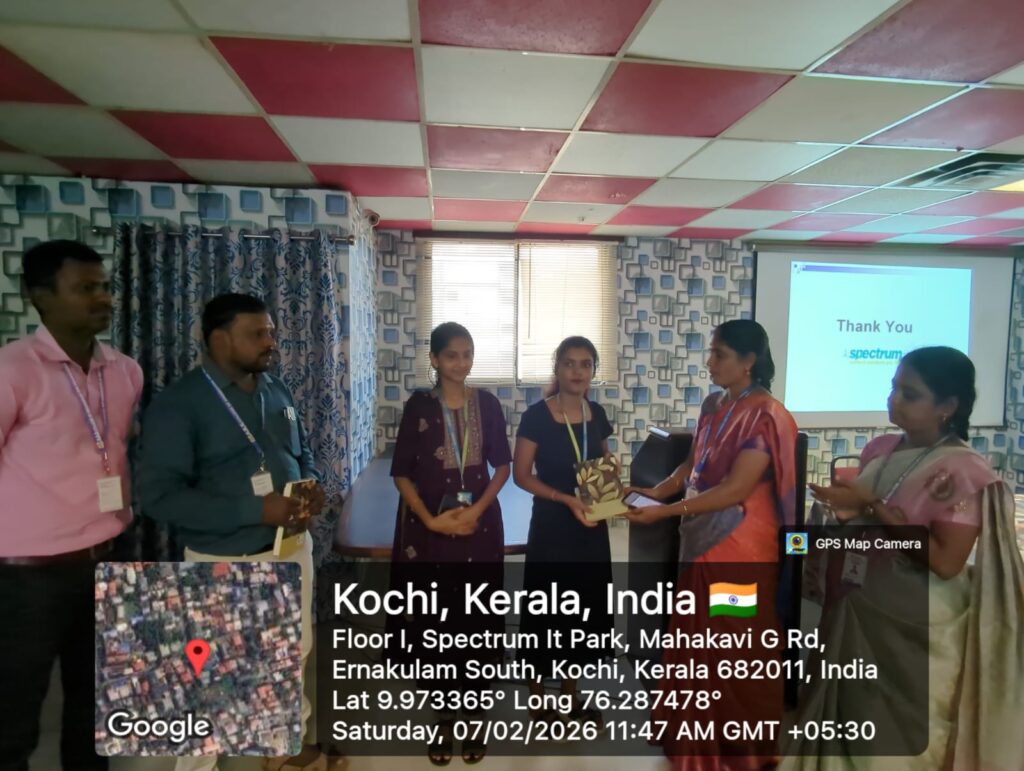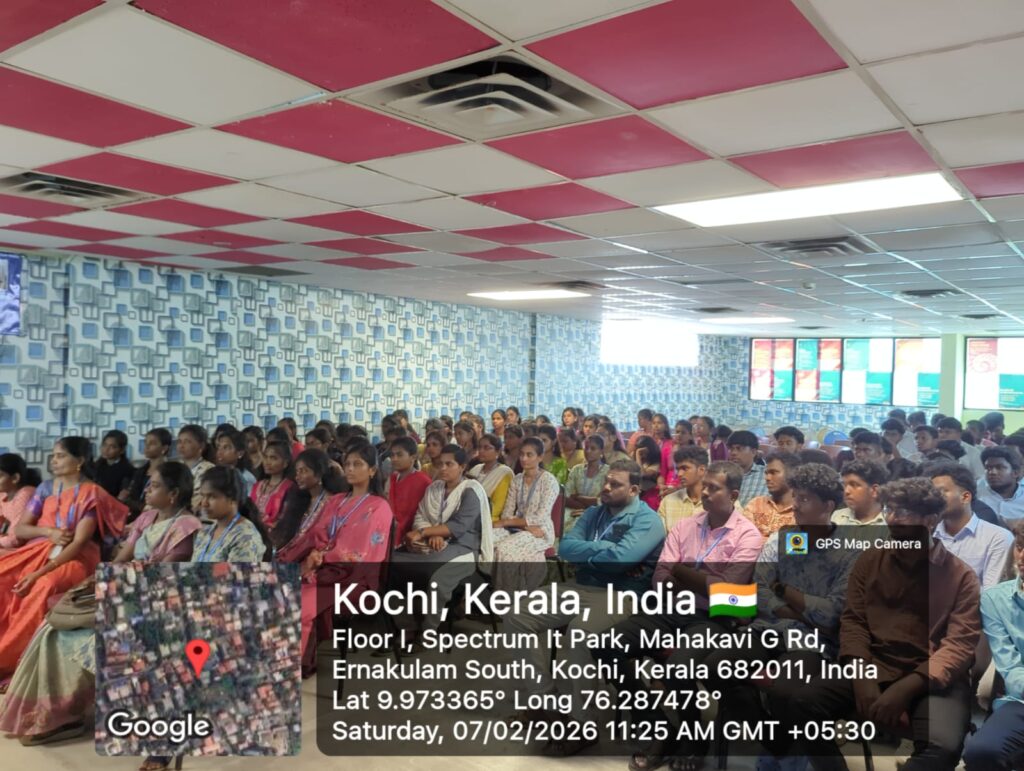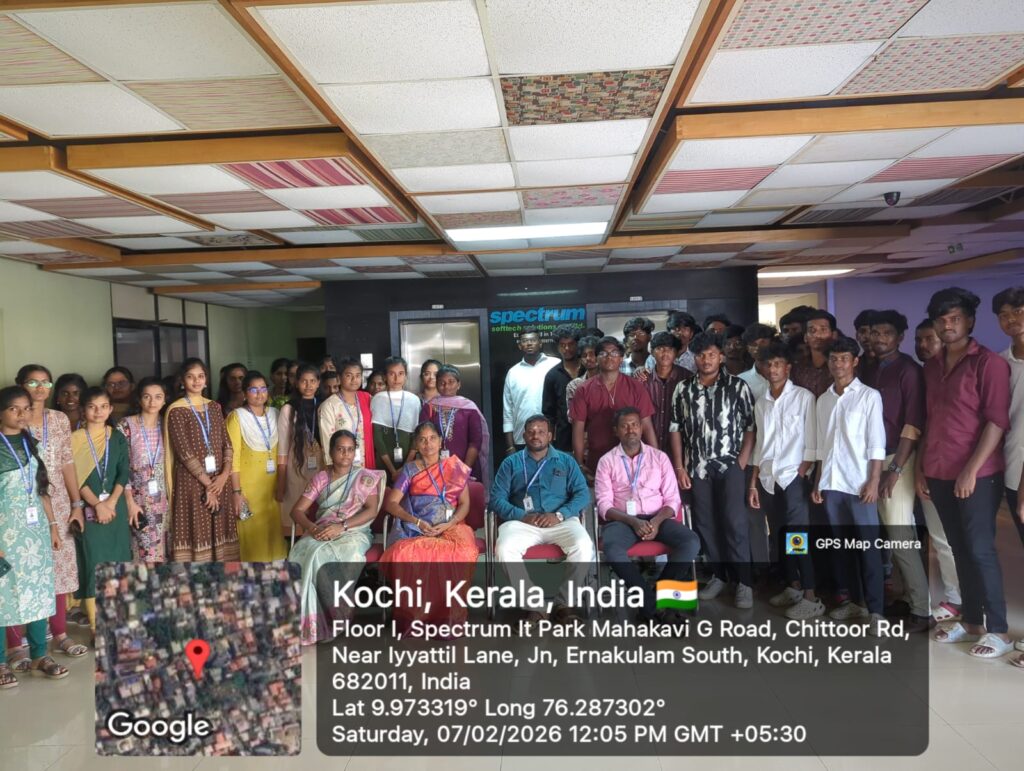
An industrial visit was successfully conducted by Technexus Students’ Technical Association on 7th February 2026 (Saturday) at 11:00 AM at Floor I, Spectrum IT Park, located on Mahakavi G Road, Ernakulam South, Kochi, Kerala. The primary objective of this visit was to bridge the gap between academic learning and real-time industry practices by exposing students to current technologies and professional working environments in the IT sector.
The visit commenced with a formal welcome by the company’s HR Divya N representative and the speaker who introduced herself and provided a detailed overview of the organization. She explained the company’s vision, mission, areas of expertise, and overall work culture. The introduction also highlighted the importance of teamwork, continuous learning, and adaptability in the IT industry.
This session helped students understand how corporate environments function and the expectations placed on engineers in real-world projects.
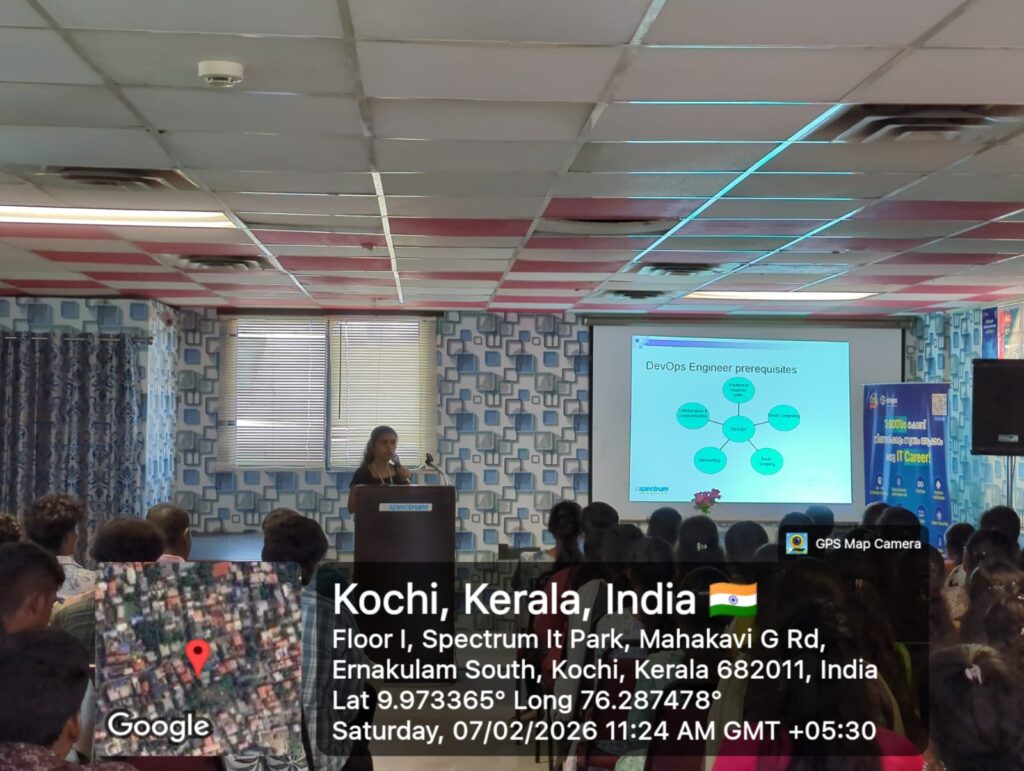
Following the introductory session, an extensive technical session was conducted focusing on DevOps concepts, which were explained in a structured, step-by-step manner. The speaker began with GitHub, emphasizing its role in version control and collaborative development. She explained how multiple developers work on a single project using repositories, branches, commits, and pull requests. This was followed by a clear explanation of servers and local servers, where the difference between local development environments and remote production servers was discussed in detail.
The session then moved on to scripting concepts and languages, highlighting the importance of automation in DevOps. The speaker explained how scripting languages such as Shell scripting and Python are used to automate repetitive tasks, manage servers, and streamline deployment processes. Students were able to understand how scripting forms the backbone of efficient DevOps operations.
Next, the speaker introduced build tools and plugins, with special focus on Maven. She explained the Maven build lifecycle, dependency management, and the role of plugins in automating tasks such as compiling, testing, packaging, and deploying applications. Real- time examples were shared to show how Maven is used in continuous integration environments.The concept of containerization was then explained using Docker, where the speaker described how applications are packaged with all their dependencies to ensure consistency across different environments. This was followed by a detailed explanation of Kubernetes, focusing on container orchestration, scaling, load balancing, and fault tolerance in large-scale applications.
A significant portion of the session was dedicated to explaining CI/CD pipelines. The speaker walked students through each stage of the pipeline, from code commit and automated testing to build, deployment, and monitoring. She emphasized how CI/CD improves software quality, reduces manual errors, and accelerates the delivery process.In addition to technical tools, the speaker explained software development methodologies, particularly Agile and Waterfall. She clearly compared both methodologies, explaining their workflows, advantages, limitations, and use cases. The Agile methodology was explained in detail, including concepts such as sprints, continuous feedback, and iterative development, highlighting its relevance in modern DevOps-driven projects.
The session was highly interactive, and students were encouraged to ask questions throughout. The speaker patiently addressed all queries, clarified doubts, and provided career guidance related to DevOps roles, required skill sets, and industry expectations. The practical approach and real-world examples used during the session greatly enhanced student understanding.
Overall, the industrial visit proved to be an enriching and educational experience. It provided students with in-depth knowledge of DevOps tools, development methodologies, and real-time industry workflows. The initiative by Technexus Students’ Technical Association was highly successful and played a vital role in motivating students to develop industry-relevant technical skills and prepare themselves for future professional challenges.