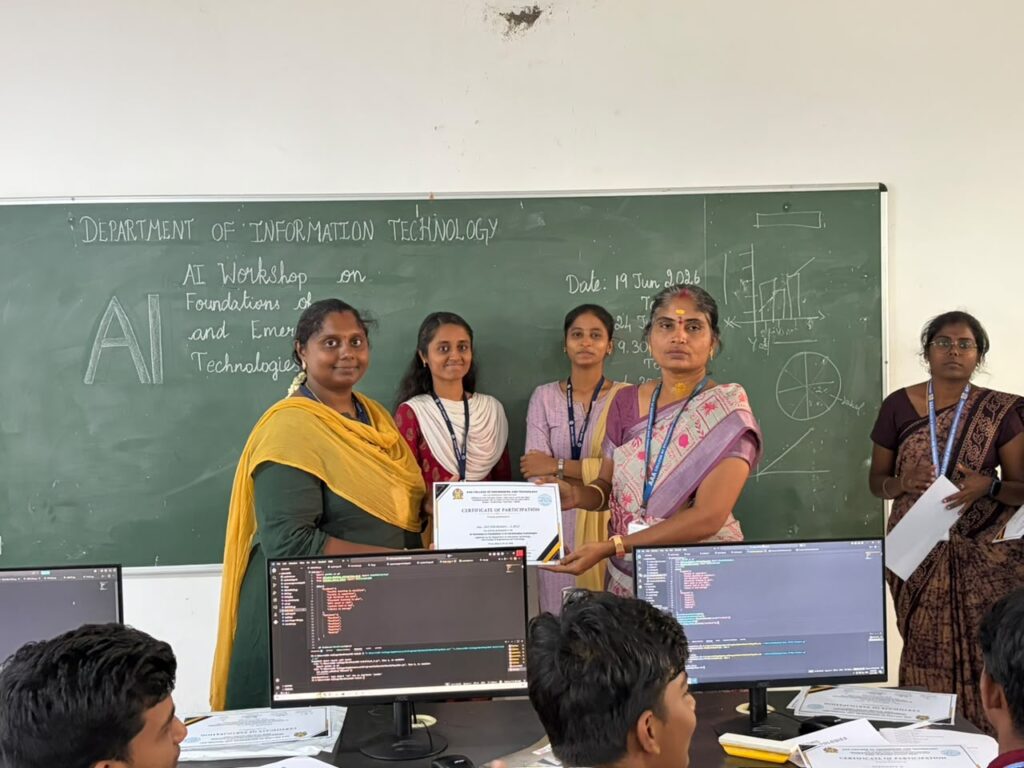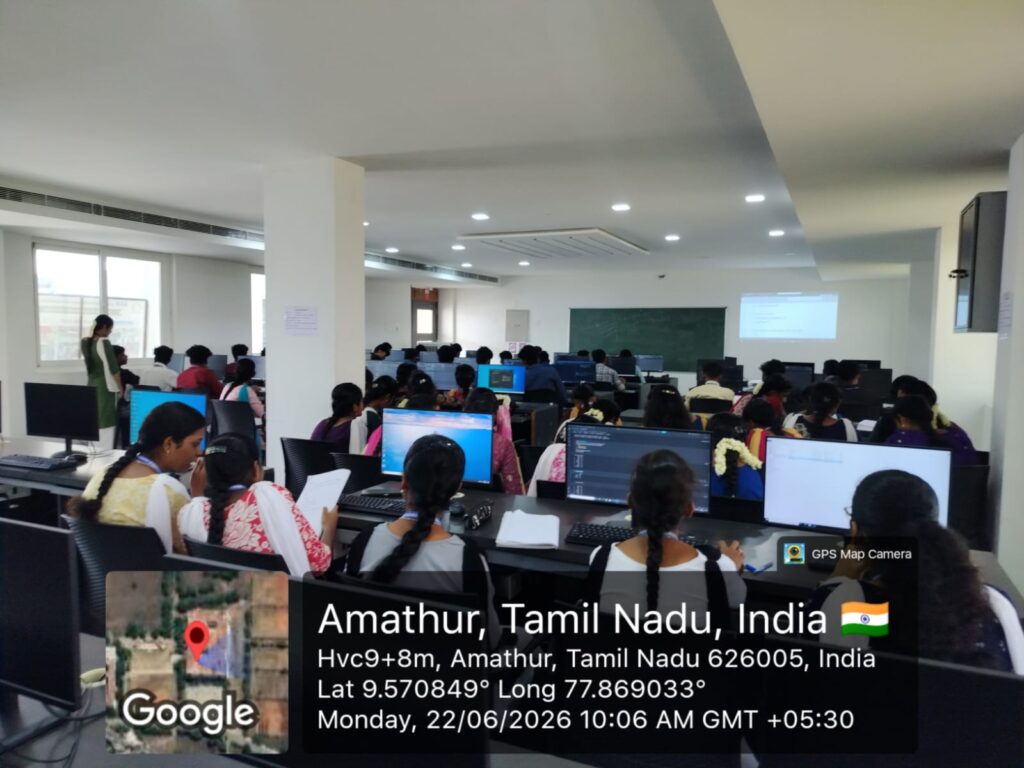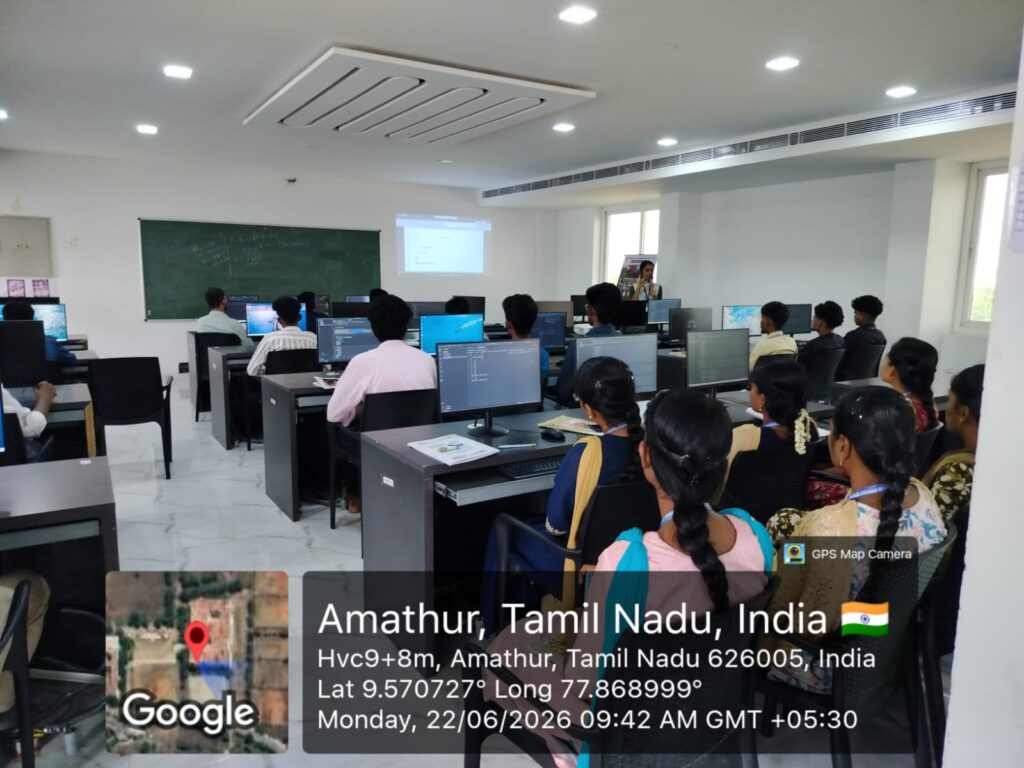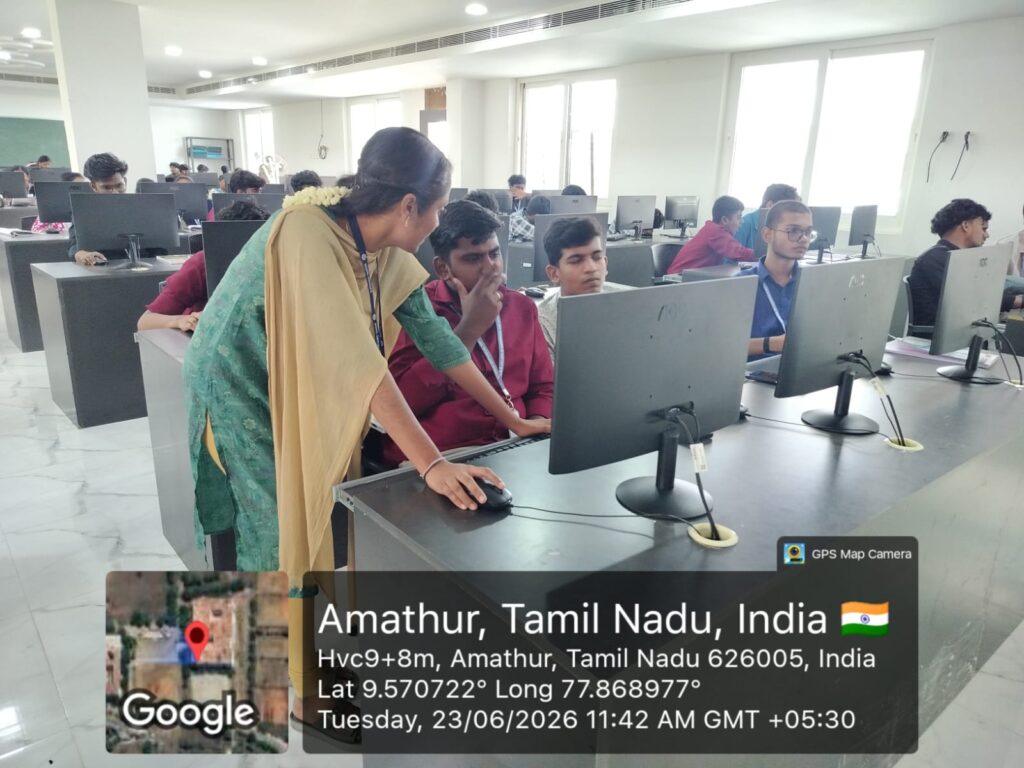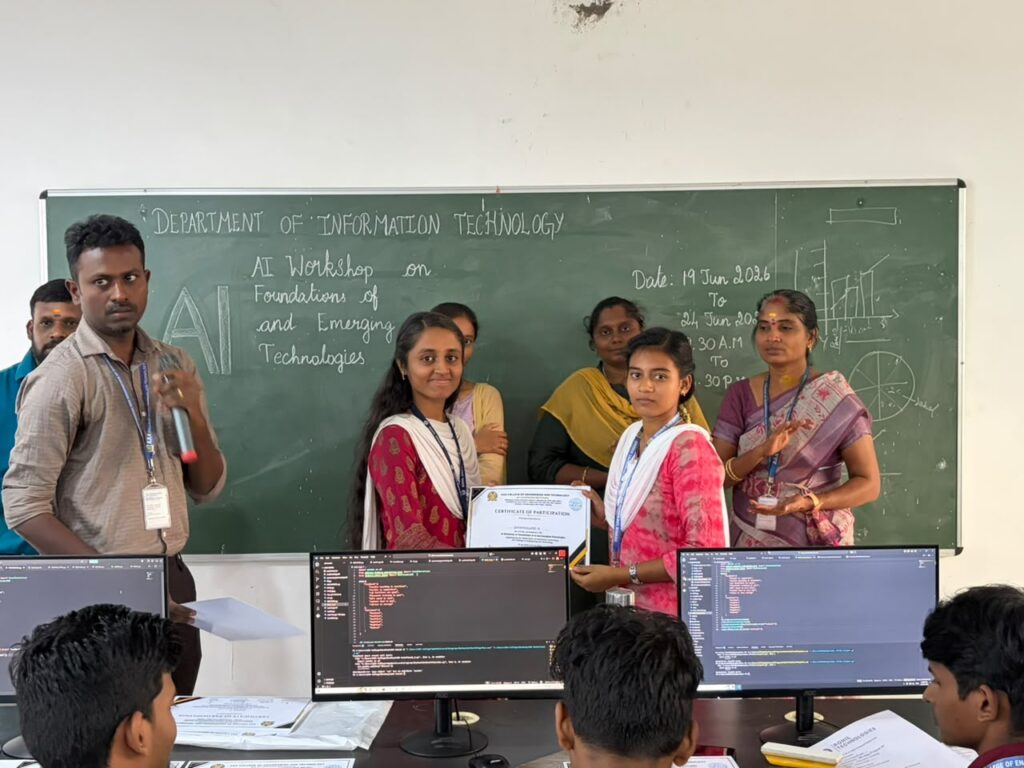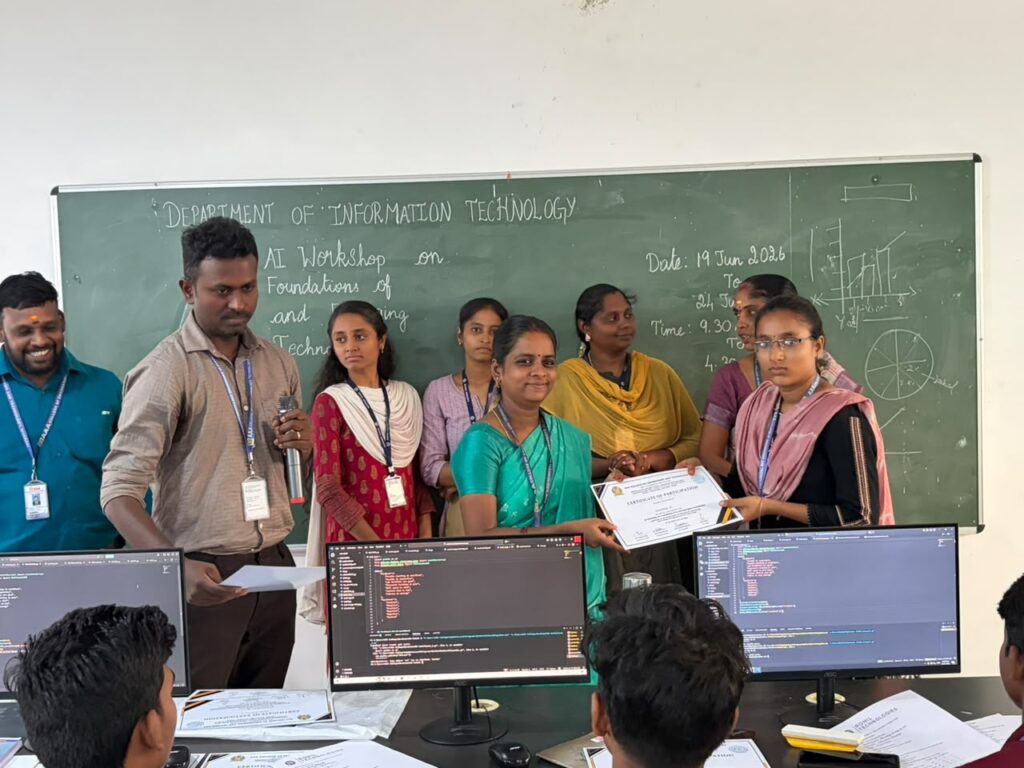



Department of Information Technology WORKSHOP ON FOUNDATION OF AI AND EMERGING TECHNOLOGIES SECOND YEAR STUDENTS
This comprehensive document serves as the official technical report for the advanced AI and Data Science Training Workshop. The intensive program successfully bridged foundational theory and deployment across 11 core technological domains. Participants transitioned systematically from entry-level data manipulation to building modern generative models.
SECTION 1: DATA ANALYTICS FOUNDATIONS
TOPIC 1: ARTIFICIAL INTELLIGENCE (AI) OVERVIEW
- Definition: Core concepts of Narrow vs. General AI.
- Landscape: Historical evolution, modern industry paradigms, and future ethics.
- Ecosystem: Mapping data engineering, data science, and deep learning.
TOPIC 2: PYTHON LANGUAGE INTRODUCTION
- Syntax: Basic structure, variable declarations, and dynamic typing.
- Control: Conditional logic statements and iterable programmatic loops.
- Structures: Memory-efficient usage of lists, dictionaries, tuples, and sets.
- Functions: Definition structures, argument parsing, and modular lambda functions.
TOPIC 3: PANDAS DATA MANIPULATION (HANDS-ON)
- Objects: Structured data querying using Series and DataFrames.
- Ingestion: Loading structured datasets from CSV, Excel, and JSON.
- Cleaning: Handling missing matrix data, deduplication, and type casting.
- Analytics: Aggregating, grouping, and merging highly complex datasets.
TOPIC 4: DATA VISUALIZATION (HANDS-ON)
- Matplotlib: Scripting foundational static line plots, scatter plots, and histograms.
- Seaborn: Generating statistical heatmaps, violin plots, and multi-plot grids.
- Interactive: Building dynamic, zoomable charts using modern plotting libraries.
SECTION 2: MACHINE LEARNING & CORE NLP
TOPIC 5: MACHINE LEARNING ECOSYSTEM (HANDS-ON)
- Supervised: Implementing robust linear regression, logistic regression, and decision trees.
- Unsupervised: Executing structural K-Means clustering and dimensional reduction.
- Framework: Data splitting, cross-validation tuning, and model serialization.
- Evaluation: Parsing precision, recall, F1-scores, and R-squared metrics.
TOPIC 6: NATURAL LANGUAGE PROCESSING (HANDS-ON)
- Text Preprocessing: Tokenization, stop-word removal, stemming, and lemmatization steps.
- Vectorization: Implementing traditional TF-IDF matrices and structural Word2Vec embeddings.
- Classification: Building supervised text classifiers for automated sentiment analysis.
SECTION 3: DEEP LEARNING & COMPUTER VISION
TOPIC 7: ARTIFICIAL NEURAL NETWORKS (HANDS-ON)
- Architecture: Configuring input, hidden, and output dense layer stacks.
- Mathematics: Computing forward propagation, backpropagation errors, and gradient descent.
- Optimization: Evaluating ReLU, Sigmoid, and Softmax activation functions.
TOPIC 8: DEEP LEARNING FRAMEWORKS (HANDS-ON)
- Environment: Setting up tensor computational graphs in TensorFlow, Keras, or PyTorch.
- Training: Tuning learning rates, batch sizes, and epoch lengths.
- Regularization: Preventing overfitting utilizing dropout layers and early stopping.
TOPIC 9: COMPUTER VISION APPLICATIONS (HANDS-ON)
- Processing: Reading, resizing, filtering, and augmenting structural image data.
- CNNs: Building Convolutional Neural Networks for feature extraction maps.
- Tasking: Training models for categorical image classification and spatial object detection.
SECTION 4: PRODUCTION IMPLEMENTATIONS
TOPIC 10: REAL-TIME SCRIPT DEPLOYMENTS
[User Request] ──> [API Endpoint] ──> [Trained Model Engine] ──> [Instant Output Response]
- QR Automation: Programmatic batch generation and optical scanning of utility matrix codes.
- Speech-to-Text: Connecting microphone audio streams to acoustic deep learning translation models.
- Image Text Extraction: Utilizing optical character recognition (OCR) engines on physical documents.
- AI Chatbot Construction: Deploying conversational rule engines and contextual intent matchers.
- Language Translation: Building neural machine translation loops for real-time phrase switching
SECTION 5: GENERATIVE AI ARCHITECTURE
TOPIC 11: THE CHATGPT BUILDING PROCESS
- Transformer Foundations: Implementing self-attention mechanisms to weigh token importance sequentially.
- Generative Pre-training: Ingesting massive raw text corpora to predict next tokens unsupervisely.
- Supervised Fine-Tuning (SFT): Curating high-quality prompt-and-response instruction datasets for specific behavior.
- Alignment (RLHF): Tuning models via Reinforcement Learning from Human Feedback using reward systems.
WORKSHOP METRICS & PERFORMANCE
| Operational Pillar | Primary Frameworks Used | Practical Labs Completed | Target Competency Achieved |
| Data Analytics | Pandas, Matplotlib, Seaborn | 3 Large Datasets | ExploratoryData Analysis (EDA) |
| Machine Learning | Scikit-Learn, NLTK | 2Predictive Models | Pipeline Engineering & Tuning |
| Deep Learning | TensorFlow/ PyTorch | 3 Neural Networks | Image & Text Feature Extraction |
| Real-time Deployment | OpenCV, Hugging Face, APIs | 5Functional Scripts | LiveProduction Integration |